Best Trekking & Hiking Backpacks in India (2026)
Two price bands, sixteen packs — what ₹2,000 buys, what ₹5,000 buys, and why the cheapest rucksacks here are the lightest for a reason you will not like.
Affiliate links — we may earn a commission at no extra cost to you. Prices last checked on 7 August 2026 from the Amazon listing.
Which trekking backpack should you buy in India?
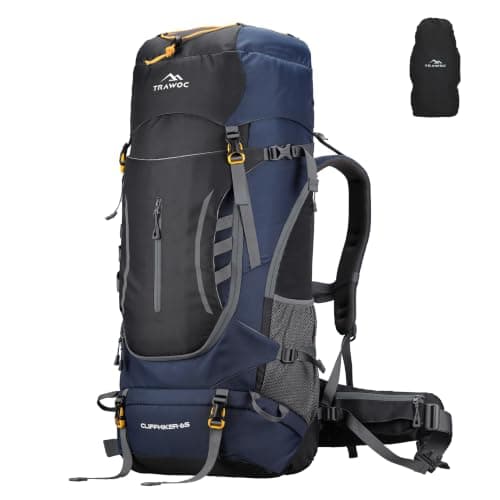
Buy in the ₹2,600–₹5,000 band if you are carrying a real load. That is where a frame and a padded hip belt become standard rather than optional. The pick there, and the best trekking backpack on this page at any price, is the TRAWOC CLIFFHIKER 65L at ₹2,627. It is also the cheapest pack in its own band.
- Under ₹2,000 — four of the ten packs have no hip belt, so lightness here is a missing harness, not an achievement
- ₹2,600 to ₹5,000 — every pack has a padded belt and a frame, and none weighs under 1.5 kg because of it
- Litres per kilo — the two bands do not overlap on it at all, and that gap is what you are paying for
A trekking backpack is the one piece of travel kit where the load, not the airline, writes the spec. Everything on both pages below is a check-in item on an Indian carrier.
So the number that decides the purchase is not litres. It is whether the bag can put those litres on your hips instead of your shoulders. Across the sixteen packs TravelPicks.in compared, that one capability separates a ₹799 rucksack from a ₹4,699 one far more cleanly than fabric, capacity or brand.
This page is the map, not the shortlist. The full rankings live on the two band pages below — sixteen packs with review evidence, pros, cons and scores.
If you already know your budget, jump straight to that band. If you do not, read the section after the bands first. These are not two grades of the same product. They are two different things, and one column in that table shows why. If the pack is flying with you, the published airline limits rule out anything from 45 litres up as cabin baggage.
Which price band are you shopping in?
Each band scores its own field against its own weights, because what decides an ₹839 rucksack is not what decides a ₹4,699 one.
10 trekking backpacks under ₹2,000 compared, ₹799 to ₹2,085 — ranked on hip belt, rain cover, zip hardware and what recent verified India buyers report.
6 trekking backpacks from ₹2,627 to ₹4,699 compared — metal frame versus fibre board, rain covers, YKK zips and what recent verified India buyers report.
What under ₹2,000 gets you
Litres, and not much else you can rely on. Four of the ten packs here have shoulder straps and nothing else. Six ship with no rain cover. Only one names its zip brand. What the band does buy is capacity per rupee that nothing above it approaches. Fifty-five litres for ₹839 is real, and for bus-and-homestay travel it is enough.
TRAWOC Stonex 60L Travel Backpack (HK001)
The only pack in its band that names its zips
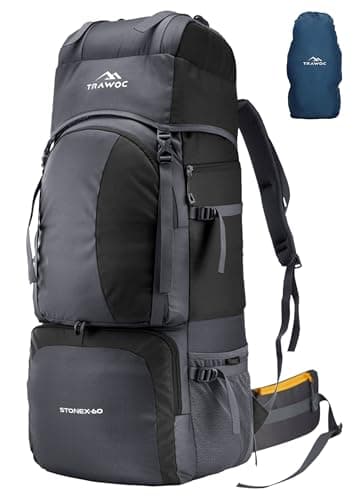
Sixty litres with YKK zippers, a rain cover in the box and a padded waist belt. The brand publishes a 3-year warranty on its own site. It is the only pack in the band that gets all four right. Just 4% of its recent verified India reviews sit at 1–2★, where the field runs to 31%. Its price has drifted to ₹2,085.
- YKK zips — the only listing in the band to name the brand, and a split zip is what ends a budget rucksack
- Rain cover included, where six of the ten packs in the band ship without one
- 4% of recent verified India reviews at 1–2★, the cleanest record on either page
What ₹2,000 to ₹5,000 gets you
A suspension system. Every pack here has a padded hip belt and some kind of frame. Five of the six include a rain cover, and three carry buyer-confirmed YKK zips. The argument is no longer whether the bag has a frame, but what the frame is made of. An aluminium rod, a fibre framesheet and a stiff fibre board all read as "framed" on the same spec table. Only the reviews tell them apart.
TRAWOC CLIFFHIKER 65L Trekking Backpack (HK010)
The best trekking pack on this page, at any price
Sixty-five litres at 1.52 kg, which is 520 g lighter than anything else in its band. It has buyer-confirmed YKK zips and a rain cover reviewers praise by name. None of its ten newest verified India reviews sits at 1–2★. It is also the cheapest pack in the band it wins. The compromise is the frame: a fibre framesheet, not an aluminium rod.
- 1.52 kg empty — 520 g less than the next lightest framed pack here
- YKK zips confirmed by buyers, at the lowest price in its band
- None of the ten newest verified India reviews is 1–2★
The extra money buys weight, and the weight is the point
Sorted by band and read down the last column, the sixteen packs make a point neither band page can make alone. Litres per kilo of empty weight is how much bag you get for every kilo you carry before packing. It does not shade gradually from one band into the next. The two bands do not overlap on it at all.
| Pack | Price | Capacity | Empty weight | Hip belt | Litres per kg |
|---|---|---|---|---|---|
| Under ₹2,000 | |||||
| Wildcraft CLIFF 45L | ₹1,825 | 45 L | 500 g | None | 90.0 |
| Hyper Adam 80L | ₹1,756 | 80 L | 900 g | Vest harness | 88.9 |
| Gear Alphamount 45L | ₹799 | ~45 L | 560 g | None | ~80.4 |
| Lifelong 80L | ₹1,499 | 80 L | 1,000 g | None | 80.0 |
| Fur Jaden 55L | ₹839 | 55 L | 700 g | None | 78.6 |
| MOUNTILE ENDURO 55L | ₹1,599 | 55 L | 820 g | Padded | 67.1 |
| MOUNTILE HIKEMATE 60L | ₹1,800 | 60 L | 910 g | Padded | 65.9 |
| TRAWOC Stonex 60LOur pick | ₹2,085 | 60 L | 950 g | Padded | 63.2 |
| TRAWOC BLAZE 55L | ₹1,800 | 55 L | 1,000 g | Padded | 55.0 |
| F Gear Orion 46L | ₹1,325 | 46 L | 999 g | Yes | 46.0 |
| ₹2,600 to ₹5,000 | |||||
| TRAWOC CLIFFHIKER 65LOur pick | ₹2,627 | 65 L | 1.52 kg | Padded | 42.8 |
| TRAWOC WILDWING 95L | ₹3,795 | 80 L (+15 L) | 2.04 kg | Padded | 39.2 |
| TRAWOC ARMOR PRO 60L | ₹3,035 | 60 L | ~1.6 kg | Padded | ~37.5 |
| TRIPOLE Colonel 80L | ₹3,846 | 80 L (+12 L) | 2.30 kg | Padded | 34.8 |
| TRIPOLE Walker Pro 65L | ₹3,730 | 65 L | 2.10 kg | Padded | 31.0 |
| Wildcraft Alpinist 55L | ₹4,699 | 55 L | 2.22 kg | Padded | 24.8 |
Every pack under ₹2,000 carries more litres per kilo than every pack above it. The lowest figure in the budget band is 46.0, on the F Gear Orion. The highest in the framed band is 42.8, on the pack this page picks overall. Nothing bridges the gap.
The five highest figures in the whole table all belong to packs with no padded hip belt. That is the honest reading of what the column measures. Under ₹2,000, a very good litres-per-kilo number usually means the load-carrying system is missing.
The clearest version of the trade sits inside one brand. The Wildcraft CLIFF is 45 litres at 500 g. The Wildcraft Alpinist is 55 litres at 2.22 kg. Ten more litres cost 1.72 kg.
That 1.72 kg is a framesheet, a padded load-sharing hip belt, and a 420D nylon dobby shell with 210D ripstop. The CLIFF is a single top-loading tube. Whether it is worth ₹2,874 depends on how far you walk. A 500 g pack hanging off your shoulders is lighter for the first hour and heavier for the sixth.
A top-loader buries your phone, wallet and papers under everything else. That is the job a waist bag worn in front does, from ₹318.
Empty weights are as each listing states them, and capacities are main-body litres. The detachable daypacks on the Tripole Colonel and the TRAWOC WILDWING are counted in the cells rather than the bars.
Warranty terms do not follow the price ladder either. Worth knowing before a brand name does the deciding.
TRAWOC publishes a flat 3-year warranty covering its ₹1,800 packs and its ₹3,795 one alike. Tripole advertises five years, and its own policy page explains the structure: "12 month fully covered warranty and 48 months limited warranty". You get doorstep pickup in year one, and shipping at your cost for the other four.
Wildcraft is the one to read hardest. Its published warranty document gives a five-year international term for luggage, and no duration at all for backpacks. Backpack cover is runners, zips, buckles and stitching. It then names zip bursts and fabric tearing among the things that void it, on a carry-in basis.
Every figure here comes from Amazon.in spec tables, brand warranty documents and recent verified India reviews. No product was physically handled. Each band page scores its own field and publishes the weights it used. Those differ by band on purpose: carry comfort means "does it have a belt" under ₹2,000, and "what is the frame made of" above it. Our full approach is on the methodology page.
Flying to the trailhead? Check the baggage limits first
Every pack on both band pages is a check-in item, and the allowance differs by airline and by fare. Our guide has the published cabin and check-in limits from all five major Indian carriers, taken from their own policy pages.
Read the cabin baggage size rulesFrequently asked questions
What is the best trekking backpack in India?
The TRAWOC CLIFFHIKER 65L at ₹2,627, from the ₹2,600–₹5,000 band. It scores highest of the sixteen packs across both bands. Buyers confirm YKK zippers, the rain cover is praised by name, and at 1.52 kg it is the lightest framed pack here. None of its ten most recent verified India reviews is 1–2★. It is also the cheapest pack in the band it wins.
How much should you spend on a trekking backpack in India?
Around ₹2,600–₹3,000 if you are actually trekking. Under ₹2,000 only if you are not. The step between the bands is a suspension system. Above ₹2,600 every pack has a padded hip belt and a frame. Under ₹2,000, four of ten have neither, and six ship without a rain cover. Beyond about ₹3,000 you buy a better frame or tougher fabric, not a different kind of pack.
Why are the cheap backpacks so much lighter?
Because the weight you are paying for is the load-carrying system. Every pack under ₹2,000 here carries more litres per kilo than every pack above it, with no overlap. The five best figures in the table belong to packs with no padded hip belt. A frame, a padded belt and tougher fabric add roughly a kilo. Within Wildcraft's own range, the CLIFF is 45 litres at 500 g and the Alpinist is 55 litres at 2.22 kg.
Do you really need a hip belt and an internal frame?
Above roughly 5 kg of contents, yes. A padded hip belt moves most of the load onto your pelvis instead of your shoulders, and the frame is what makes that transfer work. Without both, a loaded pack is walkable for minutes rather than hours. Note that 'internal frame' covers three different things here. A rigid aluminium rod, a fibre framesheet and a stiff fibre board all read as 'framed'. Only the reviews tell them apart.
What size trekking backpack do you need?
45–48 litres for day hikes and one-to-two-night trips. 55–65 litres for weekend to seven-day treks. 75–80 litres for eight to ten days with camping gear. 95 litres only for expeditions or shared kit. Bigger is not better. An oversized pack weighs more empty and invites overpacking. Here, the two largest budget packs and the largest framed one have the weakest suspension for their volume.
Which trekking backpacks come with a rain cover?
Five of the six packs under ₹5,000 include one, the Wildcraft Alpinist being the exception. Only four of the ten under ₹2,000 do. That is one of the clearest differences between the bands, and it matters in a monsoon. 'Water-resistant' polyester is a claim about drizzle, and buyers of two budget packs report contents getting wet. An aftermarket cover costs ₹150–400, so it is a solvable gap.